
Weld-On Adhesives UAE | PVC & CPVC Pipe Solvent Cement
Buy genuine Weld-On adhesives in UAE for PVC & CPVC pipe installation. Learn applications, product selection & tips for reliable pipe bonding.
6/22/20264 min read


Weldon Adhesives in the UAE: A Guide for Contractors and Pipe Installers
UAE construction sites face this very often. A mechanical contractor picks up whatever solvent cement is available on site, bonds a CPVC hot water riser with it, and the system passes the initial water test. Six months into the building's occupation, the joint softens under sustained heat and starts weeping behind a finished wall. The problem was never the pipe; it was using the wrong cement on the right pipe.
Weldon adhesives were built specifically to prevent that outcome. As a division of IPS Corporation the company that pioneered and patented solvent welding for plastic pipe in the first place, Weld-On has been producing material-specific solvent cements since 1954. For contractors and installers working across UAE construction, plumbing, industrial, and fire suppression projects, knowing which product applies to which system is the practical knowledge that keeps joints holding for the life of the installation.
How Solvent Cement Actually Works
Solvent cement is not glue. When Weldon adhesives are applied to a pipe end and socket, the solvent chemically softens both surfaces at a molecular level, loosening what IPS Corporation describes as the interpenetrating polymer network (IPN) on the plastic surface. When the pipe is pushed into the fitting, those loosened molecules from both surfaces entangle with each other. As the solvent evaporates, that entanglement locks into a bond that is structurally part of the pipe material itself, not a separate adhesive layer sitting between two surfaces.
The Weld-On Range: What Each Product Is For
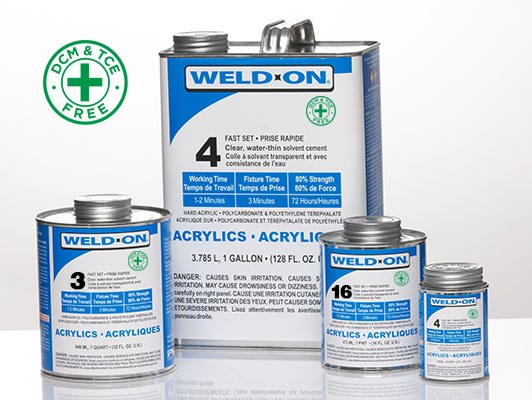
IPS Corporation offers Weldon adhesives across four pipe material categories. Each formulation is specific; they are not interchangeable across pipe types.
PVC Solvent Cements: For standard uPVC cold water supply, drainage, irrigation, conduit, and pool and spa systems. Weld-On PVC cements are available in regular, medium, and heavy body formulations.
CPVC Solvent Cements: This is where Weldon adhesives have the widest range and the most specific selection decisions to make.
Weld-On 714: Heavy-bodied, medium-setting CPVC cement for non-chemical industrial applications up to 82°C (180°F). Covers all classes and schedules with interference fit through 12" (315mm) diameter. Approved for Corzan CPVC systems. Used with P-70 Primer.
Weld-On 724: Heavy-bodied CPVC cement for chemical applications. Specifically formulated for systems carrying acids, bases, salts, and hypochlorites. The first high-strength solvent cement for chemical-resistant CPVC joints, specified in semiconductor plants and wastewater facilities. Must be used with P-70 Primer.
Weld-On 550: formulated specifically for CPVC fire sprinkler systems.
ABS Solvent Cements: For ABS drainage and waste systems. Weld-On 771 and 773 cover this application. ABS cement cannot be used on PVC or CPVC; the chemistry doesn't match, and the bond will fail.
Primers and Cleaners: Weldon adhesives work correctly only on surfaces that are clean, dry, and chemically prepared. P-70 Primer is required before applying CPVC cement on most applications it pre-softens the surface so the cement achieves full molecular entanglement.
Selecting the Right Body Weight
This is the part of the selection process that gets skipped most often. Body weight regular, medium, heavy, or extra heavy determines how the cement behaves during application and how well it fills the clearance between the pipe and the socket.
FAQs
Can I use PVC cement on CPVC pipe?
No. PVC and CPVC require different formulations. PVC cement will not produce a reliable bond on CPVC, particularly under elevated temperature or chemical exposure. Use Weld-On 714 or 724 for CPVC applications.
Is primer required with Weldon adhesives?
For CPVC applications, P-70 Primer is required before applying cement, particularly on larger diameter pipe. It pre-softens the surface to ensure full molecular entanglement when the cement is applied.
Which Weld-On CPVC cement is right for chemical applications?
Weld-On 724 is formulated for systems carrying acids, bases, salts, and hypochlorites, up to 12" (315mm) diameter. For non-chemical CPVC applications up to 82°C, Weld-On 714 is the standard choice.
How does UAE heat affect Weldon adhesive application?
High ambient temperatures accelerate solvent evaporation, shortening working time. On a larger diameter pipe in summer conditions, using a heavier body cement gives slightly more working time. Two applicators on large-diameter CPVC joints are standard practice.
Where can I source Weldon adhesives in Dubai?
Build World General Trading stocks Weld-On products from their warehouse in Al Quoz Industrial Area 2, with trade, project, and bulk supply available across Dubai and the UAE.
What Goes Wrong and Why
The failure patterns with solvent cement are consistent:
Wrong product for the pipe material. Using PVC cement on CPVC is the most common. The bond may appear to hold initially and fail under heat or chemical exposure. CPVC requires CPVC cement.
No primer on CPVC. Particularly on larger diameter pipes, skipping P-70 Primer means the cement never achieves full IPN entanglement. The joint holds until it's stressed.
Surfaces not cleaned before application. Dust, moisture, and cutting residue prevent the solvent from reaching the pipe surface properly. Clean both surfaces with the appropriate Weld-On cleaner before applying primer or cement.
Pipe not fully inserted. The pipe must be pushed to the full socket depth in one movement immediately after cement is applied. A joint that's only partially inserted has an unbonded gap around part of its circumference.
System pressurised too early. Solvent cement cures by evaporation. The cure time depends on pipe diameter, ambient temperature, and humidity. In the UAE's summer heat, evaporation is faster but larger diameter joints still need adequate cure time before pressure testing.
Ventilation on UAE Sites
Weldon adhesives are solvent-based and flammable. Solvent vapours are heavier than air and accumulate at floor level in enclosed spaces. In plant rooms, basements, or any space with limited airflow, adequate ventilation is not optional; it's a safety requirement. No open flame, grinding, or welding in the same area while cement is being applied or during the initial cure.
Final Take
Weldon adhesives are not a generic product; each formulation exists because a specific pipe material and application demands it. Getting the right cement for the pipe, using primer where it's specified, cleaning surfaces properly, and giving the joint time to cure fully before pressure testing: these are the steps that determine whether a bonded pipe system performs for decades or fails in the first year of service. For contractors and installers in the UAE who need a reliable source with the right product in stock, Build World General Trading supplies Weldon adhesives alongside the full range of pipe systems and fittings from their Al Quoz warehouse in Dubai. Contact our team at +971 43 454 178.
Address
Warehouse No. 28, Euro Gulf Warehouses, Next to Jotun Paints, Al Quoz, Industrial Area 2 Dubai, UAE
© Copyright 2026 – 2027 | Build World General Trading | All Rights Reserved